Posted by: mikenicholsblog | October 14, 2015

embrace God

My Father is teaching me to practice what I preach. Job responsibilities have led me to a very busy place. A good place, but busy. So rather than give you something new (when new would be difficult this morning), I am taking you back a few years. I hope you laugh at my weaknesses, and embrace God in the moments of today…..

From my vantage point, 21st century living is all about fast-paced lifestyles, expenses rising, house prices declining, social networking and weary people. Have you noticed that it is rare to find a person who is relaxed and joyful? Writing articles and teaching give me a chance to encourage fellow strugglers, but not to avoid the pitfalls of our overworked adrenaline-driven culture. If I am not careful, my journey is too much about daily events, and too little about living with joy. See if you can relate!

After a few days of traveling recently, I was alone for the weekend and doing some work around our house. Being on a schedule and moving at a fast clip, I made a few mistakes. One of the lenses in my glasses came out (my fault). Because I had to drive about 75 miles that evening, I just wore the glasses with one lens. It was a helpful strategy until I stopped by the drug store on my way home. After completing my business and returning to the car, I realized that the clerk probably enjoyed viewing a one-eyed customer (you can laugh … I did). During the same weekend, I inadvertently received a shock (electricity will do that). And to top it off, my phone died (not my fault).  It was off to the drug store for a cheap phone. You may laugh at my weekend, but I am sure you have your own story.

Finding balance seems elusive in our fast-paced world. My weekend illustrates that some struggles are self-imposed (glasses, shock), and some are part of living (cell phone). Could it be that if I had been relaxing in the day God had given me, some of my mistakes would have been avoided? It is easy for all of us to use our pace of life and busy schedules as an excuse, and it doesn’t take much energy to be diverted by yesterday’s failures and tomorrow’s fears. But when I (and you) live in the moment, excuses aren’t necessary.  In his book, God Is Closer Than You Think, John Ortberg shares that the greatest moment of your life is right now. We cannot change yesterday, nor control tomorrow.

So how are we to live “in the moment”, when the pace of the world we live in is not likely to slow any time soon? House prices will always fluctuate, expenses will rise, there will be Facebook and Twitter, more to do than there are hours in the day, and a million reasons to excuse our weariness. But believers in Christ are to be people of joy, whether in the 1st or 21st century. Maybe another quote from God Is Closer Than You Think can give perspective.

“We are not meant to embrace moments, but to embrace God. Moments are not always good; God is never anything else but good. Moments are simply the place where we meet Him. Every moment. Starting now.”

Not tomorrow, but right now, embrace God in this moment. It is all we are guaranteed. I shared my crazy weekend because I struggle, just like you. But when I consciously seek to embrace God in each and every moment, something is different. God gives me better perspective, and I am not as bound to the issues of yesterday and tomorrow. We will all battle our fast-paced world until He comes, but we can embrace Him in each moment and live with joy on the journey. Do it today!

yeam2015_90x90

Posted by: mikenicholsblog | October 12, 2015

pour into someone

How many people do you know whose parent’s chose to give them the biblical name Timothy? It was interesting for me this week to think of those people in my life named Tim. One of my Tim friends is a Worship Pastor in North Carolina, who I have seen go from young and talented, to a mature, gifted and wise leader. I remember sitting in the house of another of my Tim’s in the late 1980’s, seeing him rededicate his life to Christ. Today, he is serving and leading faithfully for the cause of Christ. My dentist is Dr. Tim, and he has shown himself to be a great friend and giving person during our time of friendship.  I once worked with a Tim who was a master at sharing his faith, and I attend a church pastored by a Tim who is a master communicator of Scripture.  Yet another of my Tim relationships is with a man who helps lead a bible study with me. He is one of the most positive and encouraging people you can find. Okay, at this point you may be asking, what’s the point?  Simply stated, you now know something about my friends named Timothy, but you don’t know them. It is very similar to the view we have of a man whom two books of Scripture were named after.

How many times have you read the books of 1st and 2nd Timothy? For some, the number would be twenty, thirty or even more. For others, it may have just been a few times (or maybe never). Either way, how much do you know about Timothy?

Did you know?

  • Timothy was from Lystra , a city in the Roman province of Galatia (part of modern Turkey).
  • Timothy’s mom was Jewish (Eunice), and his dad was Greek.
  • Timothy became a Christian during Paul’s first missionary journey. Some feel that Paul led Timothy to Christ personally, but my other reading doesn’t state that as a fact.
  • He joined Paul on his second missionary journey when he was in his late teens or early twenties.
  • Timothy became a special assistant, and I believe, a protégé of Paul.
  • Timothy pastored the church in Ephesus, and spent time in prison.
  • My study gives me the indication that Timothy was deeply caring, had some periods of discouragement, had some physical issues and was naturally timid in character.
  • Timothy means, “one who honors God.” And he certainly did!

Paul chose to write two letters to Timothy, which we call Pastoral Epistles.  Taking the time to read these epistles which reflect the relationship between Paul and Timothy is very meaningful. 1st Timothy 1:2 gives us a real insight into their relationship;

I am writing to Timothy, my true son in the faith.

As I think about Timothy, it’s hard to miss the fact that he was blessed with a mentor, someone who poured into his life. I was privileged to read some admonishment that Paul gave Timothy written and published by Harold Willmington, in Willmington’s Bible Handbook.  Many of these admonitions are in 1st Timothy and others in 2nd Timothy. Look at Paul’s loving counsel to his protégé.

Be a good soldier for Christ (I:18;6:12 II Tim. 2:3)
Don’t neglect your spiritual gifts (4:14; II Tim 1:6)
Guard your own spiritual life (4:16)
Denounce all sin (5:20)
Be impartial (5:21)
Pursue righteousness (6:11)
Give  yourself to God’s Word ( II Tim. 2:2/15;3:14,4:2)
Flee sexual sin (II Tim. 2:22)
Be firm but gentle ( II Tim 2:24-26)
Bring others to Christ (II Tim. 4:5).

Timothy was a blessed man to have a mentor that cared enough to help him along the journey. Timothy was godly, but Paul still counselled him. I can’t help but think that these are words that every Christ-following parent would desire to speak into their children. And to take it a step further, who cares enough for your life to pour into you? Who is benefiting from what God has done in your life? Pour into someone!

You may never get to know my friends named Tim. But hopefully you now know a bit more of the man who two books of the Bible were named after. And maybe, just maybe, you have been challenged by the fact that your life needs a Paul, and you need a Timothy. Think about it!

yeam2015_90x90

Posted by: genelnicholsblog | October 7, 2015

his poem lived on

With your permission, I’d like to take a brief detour from our focus on the various men and women of the Bible to consider the story of a modern-day(ish) believer.  I first ran across his story as I searched different hymn histories in preparation for a presentation I had to give.  I started with all my favorites, and among them I found the one I shared with the group and now also share with you.  Here is the amazing story behind “What a Friend We Have in Jesus.”

Joseph Scriven was a man well acquainted with grief.  He was born in Ireland and, as a young man, planned to follow in the footsteps of his father, joining the service as a Royal Marine.  Unfortunately, poor health prevented him from being accepted.  Life continued on, and he fell in love with a lovely young girl with whom he planned on building a life together.  Tragically, she drowned the night before their wedding.

Overcome with grief, Joseph decided to start fresh in Canada.  There he fell in love again and was due to be married, when his second fiancée became ill and died before their nuptials.  In his deep grief, Joseph decided to devote his life to serving others and became known for that very quality.

In 1855, at the age of 36, Scriven received word from Ireland that his mother lay dying.  He didn’t have the finances for a trip home, so he sent his mother a letter which included a special poem he wrote in the hope of comforting her.  The poem was called “Pray Without Ceasing,” and began with these words:

What a friend we have in Jesus,
all our sins and griefs to bear!
What a privilege to carry
everything to God in prayer!

A friend, sitting with Joseph during an illness, found and later submitted the poem to a Christian journal.  It was published under the title, What a Friend We Have in Jesus. Soon after, Joseph Scriven died.  His poem, however, lived on.

A man by the name of Ira Sankey was the musical director for a simple preacher – maybe you have heard of him – D.L. Moody!  Sankey published the poem (which by that time had been put to music) in a book of hymns and sang it quite often at Moody’s evangelistic meetings.  Soon, the song became one of the best known hymns in America and missionaries began taking it abroad.  It has remained popular for over 150 years!

A young man, who was well acquainted with grief, was also well acquainted with faith.   I was especially touched by the words of the second verse, “We should never be discouraged, take it to the Lord in prayer.”  How could someone who had experienced the losses he had, pen such hopeful and selfless words? The answer is actually quite simple … through Christ, and Christ alone.  May these words encourage and challenge you today:

What a Friend we have in Jesus,
all our sins and griefs to bear!
What a privilege to carry
everything to God in prayer!
O what peace we often forfeit,
O what needless pain we bear,
All because we do not carry
everything to God in prayer.

Have we trials and temptations?
Is there trouble anywhere?
We should never be discouraged;
take it to the Lord in prayer.
Can we find a friend so faithful
who will all our sorrows share?
Jesus knows our every weakness;
take it to the Lord in prayer.

Are we weak and heavy laden,
cumbered with a load of care?
Precious Savior, still our refuge,
take it to the Lord in prayer.
Do your friends despise, forsake you?
Take it to the Lord in prayer!
In His arms He’ll take and shield you;
you will find a solace there.

Blessed Savior, Thou hast promised
Thou wilt all our burdens bear
May we ever, Lord, be bringing all to
Thee in earnest prayer.
Soon in glory bright unclouded there
will be no need for prayer
Rapture, praise and endless worship
will be our sweet portion there.

Words: Joseph Scriven (1857)

yeam2015_90x90

Posted by: mikenicholsblog | October 5, 2015

imitate me

The year was 1991 when Gatorade first aired the “Be like Mike” campaign. If you like sports, Gatorade, or were simply alive in 1991, those words probably still resonate. Interesting enough, in 2015 Gatorade brought back the 1991 “Be like Mike” campaign. Although, in my area of the country, the newer commercial probably should have read “Be like Lebron.” Simply stated from a basketball standpoint, every aspiring player would have liked to “Be like Mike” (Lebron…sorry). When we broaden the landscape, who would any of us like to imitate in life? Athletically, professionally and most importantly, spiritually?  And without sounding like a very egotistical person, who of us would ever say … ”Imitate me?”

I know a man who did, and he was anything but egotistical in using those words. Paul was a man who was transformed from persecutor to humble servant. This radically changed man was used to pen a significant portion of the New Testament. The words of Charles Swindoll on the cover of his great work, Paul: A Man of Grace and Grit, paint a very appropriate picture of the man who was willing to say, “Imitate me.”

 “How does this cold-blooded murderer of God’s saints become perhaps the greatest Christian leader ever known? There’s only one way; He came face to face with the great Transformer—Jesus Christ, the Son of God. He encountered the Light, and the Light led him out of the darkness of sin into the brilliance of God’s forgiveness. —-He was a man of real grit, with a firmness of mind and spirit and unyielding courage in the face of personal hardship and danger.  Tough, tenacious, and fiercely relentless, Paul pursued his divine mission with unflinching resolve. And God used him mightily to turn the world upside down for Christ in his generation.”
– Charles Swindoll

To view Paul, as he served the risen Savior, was to see a man of faith, grace, and humility. He knew where God had brought him from. So when we read words like “imitate me,” how should we respond? There is something in all of us that repels the notion of telling others to imitate our lives. We are far too familiar with all of our weaknesses and faults to voice such words. So how do we view what this powerful servant said?

So I urge you to imitate me.  He could tell the Corinthians to imitate or follow his example, because his life bore the resemblance of a man fully devoted to Christ and living out the principles of God’s Word.
I Corinthians 4:16

And you should imitate me, just as I imitate Christ. This verse is set in the context of Christian liberty. Paul was giving the Corinthians counsel on following his example of exercising and practicing liberty in Christ. Paul was not being arrogant, but he was living out his faith in a marvelous way. Who better for other believers to imitate? He could appropriately say “imitate me, just as I imitate Christ.”
I Corinthians 11:1

So, should you and I ever look at other believers and say “imitate me?” A better question may be, is our faith bearing witness to the unspoken words “imitate me” written across our lives?

Make no mistake, carrying the banner of Christ has responsibilities. Christ-followers and those outside of Christ can see the evidence in our lives. Sure we are not perfect (Paul knew he wasn’t), but we are responsible to continually grow in our love for God, and love for others. If we do, maybe the words “imitate me”, although unspoken, are meaningful.

I will never say “be like Mike”
and you and I may never say “be like me,”
but I trust our lives will warrant the words.

yeam2015_90x90

Posted by: pmarkrobb | September 30, 2015

the thorn is not the thing

There is one question (or curiosity) I hear time and time again when discussions center on the Apostle Paul … what was his thorn?  I would so love to know.  It would likely be the first thing I would ask Paul if I had the chance in this life (I’m pretty sure I won’t care in the next — I’ll be too consumed with Jesus).  I wonder if I share Paul’s thorn.  I wonder if he could tell the story of it, whether it would translate into change in my own journey.

As my mind began walking that path, I paused to re-read the full passage of scripture where Paul mentions his thorn.  And as so often happens when I read the words of Scripture, I saw something different from “the thing” my mind was focused on.  In his second letter to the church in Corinth, Paul tells the story of the vision he had during his miraculous conversion and his deliberate decision not to boast about it or what he saw.  But rather than the thorn I was fixed on, I saw a far more important truth.  Let’s read together…

This boasting will do no good, but I must go on. I will reluctantly tell about visions and revelations from the Lord. I was caught up to the third heaven fourteen years ago. Whether I was in my body or out of my body, I don’t know—only God knows. Yes, only God knows whether I was in my body or outside my body. But I do know that I was caught up to paradise and heard things so astounding that they cannot be expressed in words, things no human is allowed to tell. That experience is worth boasting about, but I’m not going to do it. I will boast only about my weaknesses. If I wanted to boast, I would be no fool in doing so, because I would be telling the truth. But I won’t do it, because I don’t want anyone to give me credit beyond what they can see in my life or hear in my message, even though I have received such wonderful revelations from God. So to keep me from becoming proud, I was given a thorn in my flesh, a messenger from Satan to torment me and keep me from becoming proud. Three different times I begged the Lord to take it away. Each time he said, “My grace is all you need. My power works best in weakness.” So now I am glad to boast about my weaknesses, so that the power of Christ can work through me. That’s why I take pleasure in my weaknesses, and in the insults, hardships, persecutions, and troubles that I suffer for Christ. For when I am weak, then I am strong.
2 Corinthians 12:1-10 (NLT)

The thorn is not “the thing”.  The thorn is not the thing. (repeated for emphasis)

My curiosity about the thorn all at once seemed insignificant.  It was as if the Spirit was behind me, placing a hand on each side of my head, pointing my gaze to the word which was the real point.  “Weakness” not “thorn” is the life-changing truth.  I read this sentence again:

Each time he said, “My grace is all you need. My power works best in weakness.”

Paul pleads three different times for the thorn to be removed.

Each time he said, “My grace is all you need. My power works best in weakness.”

How many times have I wished I knew Paul’s thorn?  How many times have I missed the life-changing truth?  God knows our nature.  He knows that victorious living so often leads to our taking ownership of the victories.  But even truer is that our thorns and our suffering produce something of eternal value in our lives.  God does not allow thorns, insults, hardships, persecutions and troubles to teach us that life is hard; He allows and uses them so that His power can be enjoyed and displayed through us.  If success was all that you experienced in this life, would you be mindful of Him every moment of the day?  Would you grow to know Him more?  How could you possibly know the first thing of Christ’s suffering if you did not also share in it?  I can assure you that Paul knew.  He knew because he experienced intense trouble and suffering in his life.  Read the list he recounts in 2 Corinthians 11:24-33 if you’re curious or need a refresher.

Weakness is the thing — our weakness is the thing – not Paul’s or my, or your thorn.  Thank Him for your thorn, and stop wishing and pleading for it to be removed.  Thank Him for the grace, and watch His power work best in your weakness.

yeam2015_90x90

Posted by: mikenicholsblog | September 27, 2015

deeply lost, radically found

How many people are in your world? Oh, I don’t mean that statement in a global sense, but in a personal way. Just how many people reside in your personal world?  Do you spend time on a weekly basis communicating with ten, fifty or a hundred people? Your sphere of influence could be broad or narrow, yet there is one fact I believe to be sad, but also true, for Christ-followers. There is someone in your weekly world who you feel is not a true follower of Christ and probably never will be. You may work with them, spend time together socially, or it could be that this “not interested in Christ” person is a part of your family. We all are guilty of thinking this individual(s) will never come to Christ in salvation. Sadly, we may even have some anti-Christians in our personal world. I wonder how you and I would have classified Saul of Tarsus.

Over the next few articles, we will examine the apostle Paul. Before looking at his life as a man who was used to radically affect the world with the gospel, I felt impressed to view the pre-Paul before the Damascus road experience. Just a thought … if this man, Saul of Tarsus, had resided in your (or my) personal world, would you have mentally classified him as “probably never finding redemption in Christ.” Sadly, I would have!

A journey through passages in the book of Acts gives us an indication of what kind of man Saul of Tarsus was.  He was undeniably a persecutor of Christians. For your personal insight, you may want to look at Acts 7:58; 8:1-3; 9:1-18; 22; 5, 19 and 26:10-11. As Stephen was being stoned, look at the words of Acts 7:58…

Then they cast him out of the city and stoned him. And the witnesses laid down their garments at the feet of a young man named Saul.

The first verse of the next chapter tells us that Paul approved of the execution of Stephen. In my 21st century mind, I would never look at this man becoming a Christ-follower. But he did! And the world was changed because of it!

Part of my motivation in writing this article was to introduce Paul (formerly Saul of Tarsus). Also, I felt it necessary to challenge all Christ-followers about classifying people in our world as “not interested in Christ” and probably never will be.  A personal story will hopefully help convey my challenge. In the late 1990’s, I met a man professionally who was a great guy.  By his own admission, however, he was anything but a Christ follower. He was a hard drinker and lived life by my “not interested in Christ and probably never will be” set of rules. One day in 2004, I got a call from him and he told me he had accepted Christ and needed a mentor. After coming to Christ, he had no one to give discipleship, so he drove about 36,000 miles (his words) listening to Christian radio and when we reconnected, he was a changed man.

In the years since that call, we have talked hundreds of times.  He’s a leader for Christ, a huge witness, and, quite frankly, challenges me, and often puts me to shame with his passion. It’s an amazing story of redemption by our Amazing Savior.

My friend Jim reminds me of Paul — a man deeply lost, but radically found. Who in your world would fit the “not interested in Christ, and probably never will be” category?  Do you believe the deeply lost in your world, can be radically found? Could I ask you to stop right now, and whisper a prayer for that person in your life (whom you’ve mentally viewed as not interested) that needs to be redeemed? – And don’t stop praying!

yeam2015_90x90

Posted by: mikenicholsblog | September 23, 2015

how can He use me?

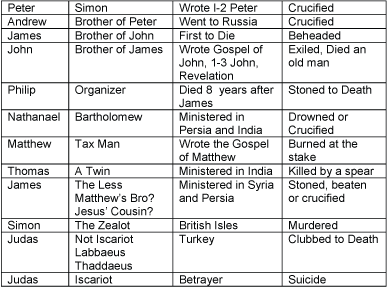
Over the last several weeks, our articles have centered on the lives of twelve men who journeyed with Jesus. It is easy when focusing on the individual apostles to miss the scope of the entire group. So as we conclude their story is our story—the twelve apostles who walked with Christ, I felt it would be appropriate to give one last glimpse at the group … as a whole. My wife originally did this chart, and I feel it puts a good exclamation on these men. Please take a moment to review each apostle to solidify their story in your mind.

 An Overview of the Twelve:

thetwelve
Twelve men with less than stellar credentials, yet they were used of God to change the world (excluding Judas). The chart was gleaned from reading the marvelous work of John MacArthur, Twelve Ordinary Men. His work gave diligence to the historical records concerning issues like where they ministered and how they died. It is amazing to picture the impact these ordinary men had on the world. Just looking at how everyone, except Judas Iscariot, is recorded to have died gives me a sense of awe, humility and “would I have been willing to sacrifice,” feelings all wrapped into one. 

We concluded this series with the replacement to Judas Iscariot, Matthias. Our next post will focus on one more apostle, who also was amazing in his impact…..The Apostle Paul.

When we see how God used these men, we must ask, “How can he use me?”

Posted by: genelnicholsblog | September 20, 2015

the twelfth

I would challenge you to name him. He is mentioned only once (and very briefly) in Scripture. We know nothing of his ministry from either God’s Word or historical records. Yet we should not conclude a study of the twelve apostles without a look at a man by the name of Matthias. Let’s take a closer look at Acts chapter 1.

During this time, when about 120 believers were together in one place, Peter stood up and addressed them. “Brothers,” he said, “the Scriptures had to be fulfilled concerning Judas, who guided those who arrested Jesus. This was predicted long ago by the Holy Spirit, speaking through King David. Judas was one of us and shared in the ministry with us.”
Acts 1:15-17 (NIV)

To set the context, the suicide of Judas had not been that long ago; neither had the ascension of Christ. The believers are meeting to make a decision about who will replace Judas and Peter is the leader. In his speech, he gives a brief recap of Judas’ demise and then quotes the Old Testament as to the decision which must be reached.

Peter continued, “This was written in the book of Psalms, where it says, ‘Let his home become desolate, with no one living in it.’ (referring to Judas) It also says, ‘Let someone else take his position.’
Acts 1:20 (NLT)

There needed to be a replacement for Judas.  There needed to be Twelve, not eleven, apostles. Again, this has to do with the Old Testament. The number twelve was significant to God’s chosen people, the Jews. There were twelve tribes of Israel. And if you do a study of Heaven, the number twelve is quite significant as well (we won’t get into that right now); Jesus had explained to the twelve apostles that they would sit on twelve thrones in Heaven. So, there had to be a twelfth man … who should it be? Now remember, there was one undeniable and necessary qualification to be an apostle … one had to have seen the risen Jesus Christ. Let’s continue on in Acts to see how the nominees were chosen.

“So now we must choose a replacement for Judas from among the men who were with us the entire time we were traveling with the Lord Jesus — from the time he was baptized by John until the day he was taken from us. Whoever is chosen will join us as a witness of Jesus’ resurrection.”
Acts 1:21-22 (NLT)

We sometimes forget that many others believed and followed Jesus during His ministry on earth. Apparently, some had also followed John the Baptist – and, of course, notice the last words there – these men had also been a witness of the Resurrection. So two men were nominated…

So they nominated two men: Joseph called Barsabbas (also known as Justus) and Matthias. Then they all prayed, “O Lord, you know every heart. Show us which of these men you have chosen as an apostle to replace Judas in this ministry, for he has deserted us and gone where he belongs.” Then they cast lots, and Matthias was selected to become an apostle with the other eleven.
Acts 1:23-26 (NIV)

Matthias was chosen as the Twelfth … and we never read about him again in Scripture! Even more puzzling is there are no historical accounts of his ministry or death (can we assume he also was martyred?). One vote, one mention and one anonymous ministry. I have always thought of this apostle as the “almost famous one,” and yet Matthias sits on a throne of honor in Heaven forever. God’s plans are perfect; they will never be thwarted.  And he uses anyone with a willing heart and faith to follow Him.

Can’t wait to meet Matthias … I have a few questions for him!

yeam2015_90x90

Posted by: pmarkrobb | September 17, 2015

unchanged and unrepentant

Always appearing last whenever a list of apostles is noted in scripture, Judas Iscariot is also the last disciple whose story we will consider.  He is singularly remembered as the man who betrayed Jesus for a handful of coins and took his own life, consumed by the deep guilt and shame of what he did.  In considering the story and person of Judas Iscariot, it would be easy to judge and dismiss him — easy to see this as a one-dimensional cautionary tale.  But here’s the thing: Judas was a disciple (one of only twelve chosen by Jesus himself), and he was not the only disciple to betray his Master.  So what, then, is true of Judas’ life and has direct application in our own?  I believe there are two things which are true of Judas’ heart and life which can also be true of anyone who claims to be a follower of Jesus.  We see evidence of the first in John chapter 12 and the story of Jesus being anointed by Mary.

Days before He travels to Jerusalem, is betrayed by Judas and crucified for our sins, Jesus is the guest of honor at a dinner party in the home of his good friend Lazarus.  At the end of the meal, Mary (Lazarus’ sister) spontaneously anoints Jesus’ feet with expensive perfume.  Judas objects …

But one of his disciples, Judas Iscariot, who was later to betray him, objected, “Why wasn’t this perfume sold and the money given to the poor? It was worth a year’s wages.” He did not say this because he cared about the poor but because he was a thief; as keeper of the money bag, he used to help himself to what was put into it.
John 12:4-6 (NIV)

In the words of his objection, we are given evidence of the condition of Judas’ heart.  This is what Jesus was always concerned for and saw directly into … people’s hearts.  He was not partial to outward expressions of belief and conviction.  He was focused solely on the heart.  Judas’ act of ultimate betrayal may be what he is most remembered for, but I am more moved by this less familiar expression of his true heart.  It is strong evidence that although Judas was chosen and followed Jesus, his heart was unchanged.  And before we judge and dismiss Judas, let us be careful to acknowledge this can also be true of anyone who professes to follow Jesus.

These people honor me with their lips, but their hearts are far from me.
Matthew 15:8 (NLT)

On that day many will say to me, ‘Lord, Lord, did we not prophesy in your name, and cast out demons in your name, and do many mighty works in your name?’ And then will I declare to them, ‘I never knew you; depart from me, you workers of lawlessness.’
Matthew 7:22-23 (ESV)

But I, the LORD, search all hearts and examine secret motives. I give all people their due rewards, according to what their actions deserve.
Jeremiah 17:10 (NLT)

The secret motives of Judas’ heart are clear in verse 6.  His life was exposed to divine power as he followed Jesus, but his heart was unchanged.

Apart from the story of Mary’s anointing and the betrayal in the garden, there is only one other mention in scripture of the events of Judas’ life.  It is a tragic story; a hopeless bit of final punctuation to his singular choice and act of betrayal.  There would be no restoration for Judas.  This stands in stark contrast to Peter’s story of denial.  Peter ran away in shame, but was lovingly, intentionally and fully restored by Jesus (John 21:15-19).  Judas, overcome with remorse and grief, threw the prize of his betrayal at the feet of the Pharisees and ran away to take his own life.  His confession was to the wrong authority.  His remorse was empty and powerless.  He was, in the end, unrepentant.  To repent is to feel remorse and confess, but it must be directed towards God and cannot be true absent a turning.  We must confess our sins, but we must also turn from them.  Judas could have been forgiven for his betrayal.  There is nothing we can do which God will not forgive if we truthfully confess it and repent.  Judas’ remorse was empty, powerless and misdirected.

I believe we should all take particular notice of this second truth of Judas’ heart and life.  Judas was unrepentant, which can also be true of anyone who professes to follow Jesus.  There is nothing that can separate us from the love of the Father, except unrepentant sin.  There is nothing which cannot be forgiven by God, except that from which we refuse to repent.

Unchanged and unrepentant are the truths of Judas’ heart and life as seen through the lens of scripture.  May his story not also be ours.  If you profess to follow Jesus, but do not possess a changed heart, cry out to Him today.  If there is a “compartment” of your heart which remains locked to His forgiveness, grace and mercy, confess and repent today.

yeam2015_90x90

Posted by: mikenicholsblog | September 13, 2015

will we?

Across time and history, quiet heroes have helped shape the world in meaningful ways.  We all like to unearth the stories of those “less than known” men and women who never made big headlines but were amazingly distinctive.  It’s interesting that most of us refuse to admit that we, too, can make contributions to our families, churches, communities and world that are amazingly distinctive. We may never make headlines (and that is not the point), but we can make a difference.

Last week, I had the privilege of reading about the three least known of the twelve apostles who walked with and learned from Jesus. On each occurrence of the list of apostles, they appear in the third group of four. If you were asked to name them, it may be a stretch for you to recite the three “lessor known” of the twelve. When we think of the apostles, Peter, Andrew, James and John quickly come to mind, and there are others we could readily recall. What then do we know about these “lessor known” of the twelve? I submit that what they accomplished was used to change the world, and in my mind they were amazingly distinctive.

James, Son of Alphaeus: Obscure would be a nice way to describe this apostle. We do know from Scripture that his mother was named Mary. In the same verse that relates to his mother, some versions call him “James the Less.” I could spend time looking at opinions of the name, but let’s just focus on what he did. In Twelve Ordinary Men (John MacArthur), we find these words about James: “There is some evidence that James the Less took the gospel to Syria and Persia. Accounts of his death differ. Some say he was stoned; others say he was beaten to death; still others say he was crucified like his Lord.” We know little, but we do know he was chosen by the Lord and helped carry the gospel to the world.

Simon, called the Zealot:  He is the second Simon of the apostles and at one time must have been a member of the sect some called Zealots. Again from Twelve Ordinary Men we read these words: “But he was a man of fierce loyalties, amazing passion, courage, and zeal. Simon had believed the truth and embraced Christ as his Lord. The fiery enthusiasm he once had for Israel was now expressed in his devotion to Christ. Several early sources say that after the destruction of Jerusalem, Simon took the gospel north and preached in the British Isles.” It is believed he was killed for preaching the gospel.

Judas, Son of James: He is known from John 14:22, as Judas (not Iscariot). In Matthew 10:3, he is called Thaddaeus. The New King James version uses the wording for this verse as Lebbaeus, whose surname was Thaddaeus.  In John 14:22, we see a tender-hearted servant when he says to Jesus: Judas (not Iscariot) said to him, “Lord, how is it that you will manifest yourself to us, and not to the world?  Why would Jesus manifest himself to a group of eleven, and not the world? That shows me a caring apostle. Jesus answered him perfectly in the next verse, but I am struck by this man Judas Lebbaeus Thaddaeus’ words to the Savior. Again, in my study, the words of Twelve Ordinary Men suggest he took the gospel north in the region of Turkey, and that tradition says he may have been clubbed to death.

I wanted to give some facts about these “lessor known” apostles, and I am thankful for books like the one by John MacArthur which provides such information. I am fairly certain a week from now most reading this won’t be able to recite much from our article, but never forget these men were mightily used of God, and for that I call them amazingly distinctive.  Most Christ-followers are in the larger family of “lessor knowns,” and I trust that our legacy will be one of intentionally carrying the gospel to our world. You and I can also leave a testimony that is amazingly distinctive. The question is, will we?

yeam2015_90x90

« Newer Posts - Older Posts »

Categories