Posted by: pmarkrobb | March 25, 2016

He chose separation

In the last week of Jesus, Friday was a deeply dark day.  It is infinitely difficult to put into words.  It begs to be experienced and not merely “told.”  Yet, Friday is also a blessed day.  It could not have been death or resurrection which redeemed us, it had to be “and.”  This first act of “and” is the solemn and grievous gateway through which we must pass to reach the joyous and radiant hope of RESURRECTION!

Our Savior’s Friday broke with the brilliant light of a most meaningful Seder and ended in the desperate darkness of a tomb.  Our own walk with Him begins with a trip to the garden.  After Seder and a song (I wonder what they sang), Jesus invites the disciples on a walk.  When they arrived at Gethsemane, Jesus instructed the disciples to sit while He went off to pray.  He invited Peter, James and John to continue with him, then the Bible says, “… and he became deeply troubled and distressed.” (Mark 14:33b NLT)  Jesus shares with the three, “My soul is overwhelmed with sorrow to the point of death.  Stay here and keep watch.”  He leaves the three of them, walks a bit farther, and under the weight of something no one has ever born before, falls to the ground.  “Abba, Father,” Jesus cries out, “everything is possible for you. Please take this cup of suffering away from me. Yet I want your will to be done, not mine.“ (Mark 14:36 NLT)

I have heard those words so many times before … Please take this cup of suffering away from me.”  For so long, I attributed those words to the suffering Jesus knew was coming on the cross road: being betrayed, denied and rejected by his own people; the physical brutality at the hands of the Roman soldiers; the spikes driven through his hands and feet and the thorns as they dug into his flesh.  I have come to believe, however, that those words don’t refer to the brutal physical and emotional suffering that was to come.  Rather, they refer to the most significant three hours in all of human history.  The hours when, for the first and last time ever, there was a separation in the Trinity.  I genuinely believe the cup of suffering Jesus was praying would be taken from him was separation from his Father.  This was the deepest pain imaginable to Jesus.  To give up being one with the Father – the intimate communion He experienced in eternity past and which sustained Him during the entirety of his days as a man — meant giving up everything.

I have learned and experienced so much about God in my role as a father.  And this revelation about separation became extraordinarily real as I readied myself for bed one night some time ago.  In that quiet space, with the thoughts of separation running through my mind, I began to feel intimately connected with the heart of God.  I became captured by a vivid memory of a time when my wife and two sons were visiting her parents for an extended weekend.  I miss my family terribly when we are separated, and that night their absence seemed especially painful.  On the way to bed, I walked into each of my boys’ rooms, grabbed a pillow from their bed and brought them to my room.  I spent what seemed like forever lying in bed, praying, holding tightly to both pillows, while laying my head on my wife’s.  Caught up in the memory of that moment, I drew so close to God I felt his arms holding me tightly.  Jesus, a Son with a heavenly Father, chose separation.  He wished for any other possible way, but He chose it.  For him it was a pain infinitely worse than the cruelest torture and death, but He was about his Father’s business … the business of redeeming the world.

Jesus chose the cross today.  He chose and endured separation today.  He died for us today.  Praise God!  In two more days, we will bask in the bright glow of resurrection, but I believe it is infinitely important that we sit a while with Friday.  Resurrection is incomplete without it.  The blanket of utter darkness which fell over the earth for those three hours that Jesus hung nearly breathless on the cross is the truest illustration of the incalculable sum of darkness from every human heart.  Every sin of every person who was, is, and ever will be born is illustrated in that darkness.  And it was for those sins, and more importantly, for us that Jesus chose the cross.  God’s redemptive story doesn’t find its punctuation today.  Resurrection is coming!  But for today, may we sit a while with the weight of what He chose for us.  He chose separation.

6_passion friday_He chose separation

Posted by: pmarkrobb | March 23, 2016

He made them new

Jesus sent a few disciples off on a sacred and purposed mission to prepare a room for a special meal.  His week would end sharing the central meal of the Passover festival with all of His disciples before continuing on to the garden of Gethsemane, where He would willingly give himself up to those who sought to kill Him.  Every step in His final week has been intentional.  No detail has been random.  And we are about to experience intention again in a deep and dramatic way.

As night fell, the time arrived, the guests were all seated, and John’s gospel says it so beautifully…

It was just before the Passover Feast. Jesus knew that the time had come for him to leave this world and go to the Father. Having loved his own who were in the world, he now showed them the full extent of his love. (John 13:1 NIV 1984)

In showing them the “full extent,” Jesus rises from his seat, wraps a towel around his waist, pours water into a basin and begins to wash the feet of His disciples.  This was: a King born in a manger; a Savior who had “no place to lay his head” (Luke 9:58); a Messiah riding on a young donkey; and a Deliverer crucified in the manner of a common criminal.  Jesus took the place and posture of a servant and showed His disciples “the full extent of his love.

The supper they shared that night was the central meal of the central festival, which celebrated the central story that defined Jewish identity … Seder.  To understand it, you have to know the story of:  God’s miraculous and epic deliverance of His chosen people after being enslaved 400 years in Egypt; the ten plagues, which caused Pharaoh to release God’s people; the plagues that appeared odd and random, but that each specifically targeted an Egyptian deity; the final plague when God did not distinguish between Egyptian or Jew, and provided a way of escape only through the sacrifice of a perfect lamb.  This was the meal Jesus was sharing with his disciples that night.

There is not adequate space to note it all, but suffice it to say there was great significance in each of the elements and specific order of the Seder.  At the top of the list were the central elements — the bread and the wine.  In the midst of this particular Seder, Jesus took these two central elements and made them new in Himself.  He did not replace them — just as He did not come to abolish the law.  He made them new in Himself — just as He fulfilled every letter of the law.

As they were eating, Jesus took bread, and after blessing it broke it and gave it to His disciples saying, “Take; this is my body.” (Mark 14:22b ESV)  The bread Jesus took was without yeast, signifying the haste with which the Israelites were to eat their last supper in captivity.  Yeast took time to rise, and God was clear that the one thing His people didn’t have was time.  Yeast is also an integral symbol in the preparation for Seder.  Jewish people take GREAT care (beginning weeks prior to Passover) to rid their houses of even trace amounts, because yeast symbolizes sin.

There was only One without sin, and that One had just taken the first of the two most central elements in this central meal and made it new in Him.  The bread was no longer just a symbol of the haste in eating the meal before the exodus; it was His body.

Jesus then took a cup, and after giving thanks he passed it to them saying, “This is my blood of the covenant, which is poured out for many.”  The Bible passage, which includes those words (Mark 14:23-24 ESV), begins, “And he took a cup.”  It is significant that the Bible says Jesus took “a cup” and not “the cup.”  There are actually four cups in the Seder meal symbolizing the four promises God gave to Moses to share with the people in response to their cries for deliverance (Exodus 6:6-7).  Those four promises are…

I will bring you out … CUP OF THANKFULNESS (start of Seder)
I will free you … CUP OF JUDGEMENT (before meal begins)
I will redeem you … CUP OF REDEMPTION (Grace after the meal)
I will take you … CUP OF COVENANT (end of Seder)

Verse twenty-three continues “… and when he had given thanks he gave it to them.”  The language scripture uses gives us confirmation of which cup Jesus took and passed to His disciples.  It was the third cup — the cup of REDEMPTION -– and Jesus says, “This is my blood of the covenant which is poured out for many.”  Jesus has now taken the second central element (wine) of this central meal and made it new in Him.  The wine was no longer a symbol of the blood over the doorposts, which redeemed the Jewish nation in the story of their great deliverance; it was His blood.

I believe it is also important to note the very next thing Jesus says.  “Truly, I say to you, I will not drink again of the fruit of the vine until that day when I drink it new in the kingdom of God.” (Mark 14:25 ESV)  Cups three and four are Jesus’ unfinished work.  The cross is still before Him, and one day He will return to take His people — all His people — home.  Can you even imagine?!  But until that day, He will not drink of these two very purposed cups.

Every step was intentional for Jesus.  No detail was random.  And Jesus had just taken the central elements of the central meal of the central festival that celebrates the central story, which defines Jewish identity and made them new in Himself. He does not replace them.  He makes them new.  And in so doing, He invites EVERYONE to the table.

We are now just hours away from the cup that Jesus pleaded with the Father to take from Him (Mark 14:36).  But for now — for today — let’s stay around the table, or even better, let’s go out into the margins and invite people in.  The bread and the wine belong to all of us!

SPECIAL NOTE:  In every other post this week, I’ve made specific and repeated mention of the particular day it was in the last week of Jesus.  Yet in today’s post, there was no mention of “Thursday.”  If you are aware of the story of the Seder, you would know it is observed on a Friday (before the Saturday sabbath).  Does that mean, then, I borrowed from Friday’s events to have something to write about today?  Actually, no.  The sacred Seder that Jesus enjoyed with His disciples took place after sundown.  Being a Jew, Jesus’ day began at sundown, not midnight (as our’s begins).  So the Seder I told of today happened on His Friday morning, which is our Thursday evening.  Totally confused?  Glad I saved that for last? 🙂

5_thursday_He made them new

Posted by: pmarkrobb | March 23, 2016

the meat wins

In traveling through the seven days that comprise a week, Wednesday represents the apex.  Also referred to as “hump day,” the connotation of Wednesday is the uphill climb toward week’s end is about to encounter its highest point, and once it is reached “it’s all downhill from here.”  Sounds about right for Wednesday of the last week of Jesus.

In my studies, I came across a literary technique with an odd name that is ascribed to the gospel writer Mark.  It’s called the “sandwich technique” and describes Mark’s pattern of breaking up a story by inserting another seemingly unrelated story in the middle of it.  This middle story typically has big action or significance (meat) and on further reflection begins to draw the outer story (bread) in with a very common theme or application.  Considered together they create a unified “sandwich.”

We find our first slice of bread in the first two verses of Mark chapter 14, with a window into the plot that is beginning to brew amongst the religious leaders.  The chief priests and teachers are looking for a “sly way” (v1) to capture Jesus and kill him.  Although there may be some unrest beginning to brew, Jesus is still very popular with the people.  The leaders are extremely concerned about a revolt, that is, if they don’t play their cards correctly.  We find the second slice of bread by jumping down to verse 10 where we see Judas approach the chief priests for the purpose of handing Jesus over to them.  They consider this a great windfall and talk terms of a deal, and Judas begins to look for opportunity.  The tension and action in the greater story is certainly reaching an apex and will begin to move rapidly downhill from here.

At the very crest of the events of Jesus’ last week, we pause and hear an amazing story of an unnamed woman and her blessed initiative.  The setting is a meal at the house of Simon the leper.  The scene fits, doesn’t it?  Are you at all surprised that Jesus would be enjoying a meal at the house of a former leper?  Yeah, me neither.  Jesus is reclining at the table with the other guests, and, contrary to proper etiquette, a woman (who would normally only approach the table to serve the men who were eating) walks up to Jesus carrying an alabaster jar.  The jar is full of what is described as “very expensive perfume, made of pure nard.” (Mark 14:3 NIV)

In doing some research, I found nard comes from very remote regions of the Himalayas in modern-day China, India and Nepal.  So it would stand to reason that this assessment of its value is spot on.  It is suggested that perfume in this quantity and of this value would likely have been a treasured family heirloom or inheritance.  I think it is fair to say this jar was the woman’s most prized possession and amounted to most, if not all, of what she had of value in this world.

She approaches Jesus, breaks the bottle, and pours the fragrant oil over his head.  Did you notice the second act in the sequence?  I believe there is deep significance in her breaking the bottle.  The unnamed woman did not simply uncap the bottle and measure her pour.  She broke it making an irreversible commitment that its entire contents would be spent in the anointing of Jesus.  A whole vessel would allow for restraint and the possibility of keeping some for herself — or even give the appearance of pouring it all out, but still allowing for an amount to be hidden and saved.  A broken vessel is an exposed vessel.  There is no hiding in a broken vessel.  A broken vessel is a submitted vessel.  One that can no longer be used for its prior purposes but rather given up fully to the purpose for which it was broken.  These are the gifts of this unnamed woman: not only her perfume, but also herself.

On seeing this act, those who were in attendance immediately began to criticize her harshly.  What in the world was she doing?!  Did she not know how valuable the perfume was and how much money could have been gained from its sale and given to the poor?!  It is important to understand that alms for the poor was a very integral part of the Passover celebration.  Much like our modern celebration of Christmas, it was customary to be very generous to the poor during the Passover season.  So in their own reasoning, the guests saw the horrible injustice and waste in this apparently frivolous act.  In their own reasoning, that is.

As quickly as they began their rant, Jesus jumped to the woman’s defense and put the rebuke back on them.  “Leave her alone … she has done a beautiful thing to me. (Mark 14:6)  In his divine, kingdom vision Jesus saw the moving of this woman’s spirit to anoint Him for burial – something that was not customary for a criminal’s body.  Knowing this would be his Son’s fate, God authored this beautiful and purposed act.  Jesus chastises the guests with the truth that they will always have the poor amongst them to offer their help to, but they will only have Him for a very short time.  And lest this be interpreted as a selfish statement, Jesus is quoting the Old Testament text of Deuteronomy 15:11 where God says, “There will always be some in the land who are poor.” (NLT)

I see a few parallels here to the events and lessons of yesterday.  First, the purposes of the natural world being in direct opposition to kingdom purposes.  In their focus on perfume and money, the guests completely missed the kingdom act of anointing.  They are focused on the denarius, while Jesus and the unnamed woman have the Father’s kingdom on their hearts.

Then, there is the greatest commandment and Jesus’ answer to the teacher of the law the day before when he questioned, “Of all the commandments, which is the most important?” (Mark 12:28) In breaking the bottle and giving it up to its final and divine purpose of anointing, the woman loved the Lord her God with everything she had.  Jesus’ words, “She did what she could” (Mark 14:8a), are the same ones He used the day before in describing the widows offering.  In response to what she did, Jesus promised that throughout the remainder of human history “wherever the gospel is preached throughout the world, what she has done will also be told, in memory of her.” (Mark 14:9)

An unnamed woman in the house of a leper approaching her Lord.  A broken vessel containing the most valuable thing she possessed in this life, poured out for the sacred purpose of anointing.  This is the delicious meat in a sandwich which is otherwise trying to be spoiled by two moldy pieces of bread.  Eventually, that bread is discarded and the meat wins.  He is Risen!  He is Risen, Indeed.

4_wednesday_the meat wins

Posted by: pmarkrobb | March 22, 2016

the kingdom of God is like…

On this specific day in the final week before the work of redemption is finished by Jesus’ death on the cross and resurrection from the grave, all those who were within earshot of the Savior went to school.  From an early morning lesson involving the fig tree Jesus cursed the day before to the last lesson of the day centered on the nature of a fig tree and His coming again, Jesus is in full-on teaching mode.  And with precious few exceptions, He teaches with story.

In preparing to write this week, I revisited my work from several years ago when I first started posting each day of holy week.  It has been a joy and also meaningful to be reminded where my heart, life and thoughts were as I began to intentionally consider the events, people and truths of this incredible week in Jesus’ earthly life.  The progression of posts about this particular day have become increasingly personal over the years.  Four years ago I focused on Jesus’ pattern of teaching and responding to questions on His final Tuesday.   I’ve since developed a particular love for His stories which begin, “the kingdom of God is like…”  God has blessed me with my own personal kingdom stories, and my pattern for posting on this day has more recently been to share those.  I pray He blesses my life with new stories in future years, but for today I revisit my very first one.

On March 26th (2014), I was copied on an email from a two-week old friend.  No, my friend was not two weeks old, but rather I had just met him two weeks earlier 🙂  Have you ever had the “chance” experience of meeting someone because of a mutual friend?  And within what seems like a breath of time, under “you-just-can’t-make-this-stuff-up” sort of circumstances, you become forever brothers (or sisters)?  That was the story of me and my friend Scott.

Scott’s email was an invitation; the result of an urgent and emotional phone call he received from a dear friend.  The invitation (to a group of several friends) was to attend a memorial service for a homeless veteran (Sam), at an inner-city Detroit church/mission.  That inner-city Detroit church/mission?  It just happened to be the place I met Scott for the very first time just two weeks earlier (under those “you-just-can’t-make-this-stuff-up circumstances” I just mentioned).

Scott provided a link in his email which told Sam’s story and the desperate search for anyone that might have known him.  The article began like this…

If you knew Sanderious Crocker, please read this.

He died.

He was 67. Folks called him Sam. He was living in poverty in downtown Detroit. A Vietnam veteran who was seriously wounded, he’d been homeless for a while. He struggled with alcohol. Maybe you know this. Maybe you don’t. Maybe you lost touch. Maybe you wanted to.

Whatever the case, you should know that Sam’s body had been sitting at a Detroit morgue for a week before a friend called me and asked whether there was a way to find his family — any family — because a soldier shouldn’t die alone and neglected.

My then fifteen year-old son joined me in meeting up with Scott and a couple of his friends in the parking lot of a local restaurant to share a ride to the memorial service.  I cannot possibly share all the sacred details of that day, but there is one which I must.

I met another new friend in the parking lot that day.  His name was John, and he was our “driver” for the day.  John, like Scott, was a Vietnam veteran.  I would later learn of the amazing things he was doing to heal both his wounds and those of others via service projects in Vietnam through the D.O.V.E Fund.  John had brought a personal memento which he felt had significance to where Sam had fought in Vietnam.  He intended to give it to Sam’s family (a very small measure of which had been found as a result of the newspaper article and the power of the internet).  I learned a forever lesson about the power of healing in simple acts and gifts of selfless love from John that afternoon.

The trip to the church was short.  As we exited the highway and turned the corner onto the street where the church stood, I was completely overwhelmed by what I saw.  Something close to a hundred motorcycles lined the street adjacent to the church, all with American Flags proudly flowing in the breeze behind them.  There was also what seemed like hundreds of people milling around in the street.  I was so moved; I couldn’t speak.

It was an amazing service, with all the solemnity and ceremony of a military funeral.  Tears drenched my handkerchief as scores of veterans paid their respects walking past Sam’s casket.  There was music, moving words from people who served at the church/mission, and a beautiful message delivered by the pastor of the church.  Sam was a close friend of the founding pastor (who had since passed away) and had been a resident at the mission several times over the years.  From the stories that were told, it was apparent Sam was well-loved.  He had a happy childhood and a bright future, but fell completely off the grid after returning from Vietnam with a body, mind and life ravaged by his experience of war.

In the days preceding it, I began to feel a prompt to prepare words for the service.  I fought those prompts and struggled with their source and reason.  I didn’t know Sam and had no earthly idea why I should be prepared to say something at his memorial service.  Yet, in the most ordinary of activities (like mowing the lawn), words began forming in my mind.  Those words found their context and resonance when we turned the corner that afternoon.

What I saw in the formation of motorcycles, and continued to see in the sacred souls who had gathered for that hallowed occasion, was a vivid image of the kingdom of God.  Unnamed people from every corner of life simply showed up, because a soldier shouldn’t die neglected and alone.

In finding an appropriate spot in the order of service, I chose to be obedient to the prompting of the past few days.  “Sanderious never knew my name, and I was only introduced to his a few days ago.  This section of the service reads, ‘Remarks …. Family and Friends.’  You might be wondering what right I have to be standing here right now.  What would motivate me to stand and speak?  I would quickly and confidently answer that although we did not know each other in life, I stand up as family for Sanderious today because we are brothers in the kingdom of God.  Sam believed in Jesus, and that makes him my brother.”  I went on to share how the images of that day were a loud and clear reminder of how we should all act as members of the kingdom of God in the here and now.  The simple act of showing up for one of our brothers or sisters … it should never be any more complicated than that.  With my final few words, I shared how it was divinely fitting that we were all gathered together on Good Friday to remember a precious child of God, and what Christ did for him, and for us all, by dying on the cross.

I apologize if my narration of the story sounded disjointed or carried on too long.  I wish you could have experienced it with me!  And I’ll be quick to draw attention away from my own words and actions, because they are not included for the purpose of inserting myself into God’s story.  All the attention and glory goes to the One who made it all possible by gifting that day to me, my son and all my brothers and sisters who attended.  All I hope to say, with this story is:  The kingdom of God is like … the sacred, solemn and joyous memorial service of Sanderious Crocker.

3_tuesday_the kingdom of God is like

Posted by: pmarkrobb | March 21, 2016

the tree and the temple

If you study today (Monday) in the last week of Jesus, you will find it is all about a tree and a temple.  The temple story is more dramatic and well-known (the scene where Jesus upsets the “money tables” and clears the temple of all that has corrupted it), but it is his early morning teaching (when Jesus “happens upon” a fig tree) which truly sets the table for the temple action to come.

In Mark 11:12, we find Jesus walking the mile and a half path from the town of Bethany to Jerusalem with his disciples.  Not far out of town he spots a fig tree in full leaf.  This would not have appeared odd at first glance, since fig trees in that region would be in leaf at that time of year.  The tree would also typically have small “knobs” called taqsh (pronounced tuhk-wAAsh), that would drop off before the real figs formed.  The taqsh were edible and would often be offered to or eaten by the poor.  It is additionally important to note that if a fig tree in full leaf in the spring did not have taqsh, there would be no fruit on that tree that year.  This is how Jesus finds His fig tree – in full leaf, giving the clear impression to any passer-by that there was fruit.

Jesus knows, of course, there is no taqsh on this particular tree, but he takes the opportunity to teach a critical lesson applicable to the life of any believer.

Then Jesus said to the tree, “May no one ever eat your fruit again!” And the disciples heard him say it.
Mark 11:14 (NLT)

I wonder if the curse seemed a bit drastic to any of the disciples.  Was Jesus hungry and became angry when he discovered that his hunger would go unsatisfied?  Obviously, no.  Then why would Jesus stop and curse a fruitless tree?  I believe that particular tree symbolized something He never wants to be true in the life of anyone who chooses to follow Him.  In his curse Jesus seems to be saying, “Don’t be a believer deceiver.”  Don’t be someone who takes great care and effort to give the appearance of a follower (a tree in full leaf), but instead brings shame to God’s name by the way they live.  This tree is a poison to the kingdom Jesus was there to announce.

Without any explanation of His curse, Jesus continues onto Jerusalem with his disciples.  But before we arrive at the temple, I believe it is critically important to note it was not the first time Jesus had been there this week.  As parade day ended, Mark 11:11 records:

And He went into Jerusalem and into the temple complex. After looking around at everything, since it was already late, He went out to Bethany with the Twelve.

Sometime in the late afternoon of that joyous day, Jesus purposed a visit to the temple.  The Bible doesn’t describe the scene, but I imagine Him finding a moment to slip away from His disciples and the crowd (He often did this to pray, so there is precedent).  Because His temple visit is not described in any great detail, one might believe Jesus simply took a stroll through, and because it was late, left and went back to Bethany.  But a closer look at the Greek suggests that this “looking around” was anything but a casual stroll.  The Greek word “periblepó” (translated as looking around ) means:

from peri – all around and blepó – look at, gaze on : properly, gaze all-around; closely observe with a sweeping (encompassing) look and with high personal involvement (self-interest).

This is far from casual.  This is intensely observational and personal.

Much time and history had transpired since Solomon was assigned the task of building a fitting house for God.  The temple had since been destroyed and then rebuilt by Herod.  And while it was an architectural marvel, it was a far cry from a house of prayer or dwelling place for the Most High.  To properly set the context, this Monday fell in the midst of the Passover festival, which over time had grown to become quite a spectacle.  Hundreds of thousands of out-of-towners made the annual pilgrimage to Jerusalem, and the temple was at the center of the celebration’s bustle.  Passover had become big business.  ”Vendors” packed the temple offering a myriad of services to the Passover pilgrim to “aid” in their celebration.  Before purchasing your Passover lamb, you first had to make a stop at the currency exchange booth, where someone was ready to take your native currency and exchange it for temple coinage (at a profit, of course).  Also, from all I’ve read, it wouldn’t surprise me to see the modern-day equivalents of a t-shirt vendor, carnival game operator and timeshare salesman, all packed within the temple walls, ready to “service” their out-of-town guests.  The once holy and sacred space had, over time, become more of a human institution.  Temple currency was created to generate a profit for those who controlled and exchanged it.  There was an entire enterprise structure built around acquiring a suitable sacrificial animal.  There were merchants, inspectors, priests, and (at every level) corruption that lined the pockets of the privileged few at the expense of those who had little.  It had become the fig tree in full leaf that Jesus “happened upon” in His morning walk to Jerusalem.

Jesus observed it all the evening before. That simple fact changed everything about what I saw as His “temple tantrum.”  Jesus’ actions on Monday were swift and sweeping but meant only to reclaim what belonged to his Father.  Jesus made a mess of the mess that had been made of his Father’s house.  And in the midst of the cleansing, scripture says that Jesus taught and reclaimed the temple as a house of prayer for all nations.

The tree and the temple – one cursed and one reclaimed.  Both are strong and conjoined lessons of God’s hatred for the outward appearance of fruit with no evidence within.  May the events of this day cause us to honestly examine our own lives and allow the Spirit to do any necessary house cleaning.  This week, as we join with our communities of faith and enter our houses of worship to remember and celebrate, may we follow Jesus’ example and “look around.”  What do we see, hear, taste, touch and smell?  Are they houses of prayer where those on the margins are welcome?  Are there some “tables” which need to be purged?

May our fig tree be in full leaf and possess the fruit of a true follower.  May God allow it to be nourishment to someone in need.  What a blessing to walk together in the footsteps of Jesus as He knowingly and willingly walks in the direction of the singular purpose of His earthly life.

2_monday_the tree and the temple

Posted by: pmarkrobb | March 20, 2016

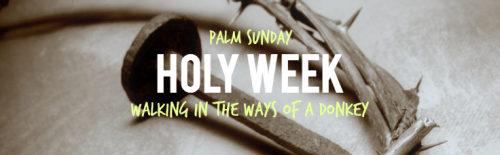
walking in the ways of a donkey

Today is a very significant day in the life of every Christian.  Palm Sunday is the gateway through which we enter holy week.  A week of incredible significance begins with Christ entering the city of Jerusalem, received and lauded as a king, and ends with a resurrected Savior.  But as you may already know, those two glorious points of punctuation are not even close to the full story.

This is my eighth consecutive year of practicing Lent and walking with great intention through holy week.  In my pre-Lenten years, Palm Sunday was just a 30-second commercial spot for the anticipated “big day.”  There were palm leaves and talk of new Easter outfits.  There was the reminder to purchase baskets, fill plastic eggs, and plan the Easter morning “hunt.”  It was the anticipation of a short work week, with Good Friday relegated to not much more than a welcomed vacation day.  It was “season treason” and full of everything but spiritual significance.

Then came the casual inquiry from a friend as to whether I had ever practiced Lent?  And on that blessed fulcrum, the spiritual momentum of my life began to tip in a wholly new direction.  The time of Lent, and my practice of it, has become central to my true self.  The specific emphasis on holy week has awoken within me an entirely new and deep sense of gratitude for what Jesus did for me (and for you).  It blew the cap off the bottle where I had put the Passion part of Easter.  It brought true and vibrant colors to each day in my walk from parade to resurrection.  The bright colors pop. The grays and blacks have taken on new contrast and depth.

So today, I begin where holy week began, with a King riding into town … on a young donkey.  I have known all along this donkey was significant to Jesus’ “triumphal entrance” story, but I had always stopped at the reasons of prophesy and humility.  In Zechariah 9:9-10 it was prophesied that Christ would arrive on the back of a donkey.  And as for humility, it’s pretty easy and obvious to make that connection.  Christ’s two big entrances were both made in great humility:  born, not with a herald in the halls of a gilded palace, but in the anonymity and modesty of a feed trough in a common stable; riding into Jerusalem as a King, not on the back of a noble war-horse, but on the foal of a lowly donkey.  These are perfect illustrations which seem to wrap up the significance into a nice neat package.

Several years ago, I was introduced to a deeper significance in God’s choice of this animal.  I am certain my father-in-law had explained this to me before (having owned a mule — the offspring of a male donkey and female horse — for many years), but in my studies I learned, a donkey is a very smart animal.  It is quite true to its description as a beast of burden, but do not be mistaken.  This is no clueless, led-around-by-the-nose farm animal.  It is equal parts stubborn will and faithful servant … and this is where I found the nugget.

I found an Old Testament story (Numbers 22:21-35) about a prophet (Balaam) who rode on a donkey, which saw an angel, refused to confront the angel, got off of the path and was beaten by the angry prophet … how’s that for cliff notes?  I believe the story reveals a great truth about the donkey.  Namely, it senses danger and stubbornly refuses to go headlong into it.  A horse?  Sound the bugle, kick your heels, and he goes charging.  But a donkey?  No way, sister.  You can push and prod all you want, but this animal is holding its ground.  I found an interesting parallel when considering the near complete absence of any action on Jesus’ part after His dramatic entrance into Jerusalem.

It was the most opportune moment to charge onward to seat of power with the full support of an adoring and boisterous crowd, yet Jesus did nothing.  The people waved palm branches (a symbol of military victory) and cried “Hoseanna!” (which in Hebrew means “save us” or “save us now!”).  This was a perfect storm for a conquering king.  There had to be some talk or even possibly significant pressure to act.  The people expected Jesus to be their deliverer — a man of action who would bring the rod and make right all those times when they were at the short end of the conquering stick.  Yet, rather than rising to the purposes of the people, Jesus stopped and walked off their path.  This King was not here to conquer earthly kingdoms.  This King knew His time, walked His own path, and refused to move at another’s pace or for another’s purpose.

If you can see that parallel, I’d like to suggest one more.  This one has to do with a donkey’s true nature.  It is very much a beast of burden, who bears those burdens as a wise and faithful servant.  Balaam’s donkey knew not to confront but also did not run.  He submitted himself to the beating of an angry prophet, because the alternative was going against the messenger of God.  In what amounts to the first steps of His walk to the cross, Jesus did not confront nor did he run from the suffering He knew was coming.  He submitted to God’s purpose and became the bearer of the greatest burden there ever has or ever will be — the weight of the sins of every person for all time.  In His birth and life, there was never an intent to take an earthly throne.  In His death, Our King’s earthly throne would be a cross.  There He would hang — in His true nature — the full weight and burden of all our sins, faithfully born.

In Jesus’ stubborn and unfailing will, He paid the price so that we might live.  What a perfect choice God made in his plan for Christ’s entry and for our redemption.  Let’s all go into this week, and the remainder of the days God has for us, walking in the ways of a donkey.

Join us as we journey intentionally through holy week.  Take time each day to search the scriptures and follow Jesus’ path to the cross, the grave, and out of the tomb.  What an amazing punctuation we have waiting for us at the end of this week.  Let us not reduce its meaning by running past the deep significance in the details of Jesus’ final days before death and resurrection.  He is risen!  He is risen indeed!!

1_palm sunday_walking in the ways of a donkey

Posted by: mikenicholsblog | March 16, 2016

beyond twenty-six

This coming Sunday, one of our Journey onWord writers will continue a series he started several years ago.  Daily posts which intentionally walk from Palm Sunday to Resurrection Day in Jesus’ final week. We have found it to be meaningful and personal to our readers, and I trust you will enjoy the journey with us this year. Before we begin that journey, look with me at one of the failures from Passion Week.

As someone who depends on his phone for both work and pleasure, I must admit that cell phones have also been a source of great irritation. Several years ago, I dropped (and lost) a phone on Park Avenue in New York City (my daughter was thoroughly amused that I thought I could go back and retrieve it!). On another occasion, I left my phone at an airport in Chattanooga at 4:30 in the morning. I have dropped a cell phone in water (it died), called people countless times without knowing it, and even had a phone die on a trip while sharing Christ with someone. It amazes me that I can search Google, listen to music, check email and talk with a lady named Siri on such a small device.  You may think I’m a cell phone failure, but there is hope (I’ve actually stopped talking back to Siri)! I relate well to another failure. You may have heard of him … His name is Peter.

When reading Matthew chapter twenty-six, the garden of Gethsemane takes center stage. With good reason! Peter’s life is woven among the verses, and not in a flattering way. His weakness abounds and resounds. Talk about failure! Take a glimpse at how bad this chapter was for him.

Matthew 26

  • Peter declared that he would never disown Christ.
  • Peter and two other disciples were sleeping during a critical time for Christ in Gethsemane.
  • When Christ was arrested, Peter drew a sword and cut off the ear of Malchus.
  • He and the other disciples deserted Christ.
  • Before the rooster crowed the morning after his bold declaration, Peter had denied Christ three times.

Just then a rooster crowed. Peter remembered what Jesus had said: “Before the rooster crows, you will deny me three times.” He went out and cried and cried and cried.
Matthew 26:75 (MSG)

Talk about a failure!

But thank goodness Peter’s story did not end with chapter twenty-six. He was restored and used of Christ to dramatically impact the world. Peter was blessed to preach at Pentecost. God used him to open the door of the gospel to the Gentiles. Peter wrote two epistles in the New Testament. And church history records that he was crucified upside down because he did not feel worthy to be crucified as His Savior was. Peter’s incredible failures are hard to miss, but even more incredible is the way God forgives, restores and uses someone who is fully devoted to Him.

You may not be as brash as Peter or as cell phone challenged as me, but I am sure you struggle with failure. Repeatedly, you are reminded of your weaknesses. You may even have some “twenty-six” type chapters in your life. Whether our failures are public or private, they can cause us to lose effectiveness for the Savior. I am here to tell you that God can handle your weakness and failures, and can use them for His good and your growth. Peter could have pulled back or ran away after denying Christ. But for the cause of Christ, and because of God’s incredible grace and love, Peter’s story ended well. No matter how deep and numerous our failures, our story can end well too.

I’m sure I’ve not seen the last of my cell phone frustrations. Failure will be part of the story we all write. But it should never be the end of the story. Peter’s life moved beyond chapter twenty-six. Whatever holds you back from effectiveness for Christ can be overcome. Let your next chapter be filled with growing deeper in love with the Father, and with others. Use Peter as an example!

I wonder what Peter would have done with a cell phone?!

yeam2016_graphic

Posted by: mikenicholsblog | March 14, 2016

which is winning?

Most people, even those who hold the truth of Scripture closely, have sensed the tension that erupts between our beliefs and feelings. We would all like to avoid the tension but, in reality, it seems ever-present and always ready to erupt. During a leisurely six-hour wait in the Atlanta airport on Friday, there was a brief moment where what I was reading in Scripture (my Bible was still open) and what I felt, came quickly into conflict. Thankfully, because the Word had just made an impression on me, my initial inclination quickly evaporated. But there was tension!

Isn’t it easy to be thankful when God is providing and there is a sense that everything is okay financially? My wife and I pray about finances, our business, and when to honor God with what He places in our hands. So why would I sense tension between the Word and my feelings? After about four hours in the airport, I called my wife. She proceeded to tell me that a man called and shared a heart wrenching story about someone in need. He shared how this person would be evicted if the rent wasn’t paid soon. And in reaching out to people, Genel (my wife) came to his mind. My wife, after hearing the story and trusting the spiritual integrity of the caller, felt she needed to help. During our call, she wanted to know what my thoughts were. Well….

It sounded a little skeptical to me at first. Was the caller being used? Why was this person always in need? To my dismay, those were not real spiritual thoughts. Oh, the tension between the Word and my feelings! For me, the issue wasn’t about the person in need as much as it was about how tightly did I want to hold on to what we’ve worked hard to accrue. But wait; don’t we pray about our finances and believe that we are stewards of God’s resources? Sitting at gate C10, I was facing a conflict between what I now feel was an absolute call to give, and my own selfishness. Shame on me!

My reading had just been in Deuteronomy 8, and as I said before, the Bible was still open. My reading was from the Message, and look at what verses 17-18 stated:

If you start thinking to yourselves, “I did all this. And all by myself. I’m rich. It’s all mine!”—well, think again. Remember that God, your God, gave you the strength to produce all this wealth so as to confirm the covenant that he promised to your ancestors—as it is today.

It was great reading … that is, until Genel called and I was confronted with my feelings. After all, I work hard and I don’t really know this person … is their need valid? Shame on me! For me, it really wasn’t the need, as much as how I responded. Thank goodness Genel’s sense to help was strong. I could have easily made a huge mistake by forgetting my role as a steward, and holding God’s provision too tightly. In the Life Application Study Bible (NLT), great commentary is given on Deuteronomy 8:11-20.

“In times of plenty, we often take credit for our prosperity and become proud that our own hard work and cleverness have made us rich. It is easy to get so busy collecting and managing wealth that we push God right out of our lives. But it is God who gives us everything we have, and it is God who asks us to manage it for him.”

Thank goodness I had just been reading the Word when the call came. It caused perspective to come quickly and challenge my selfishness. Our feelings dart and twist like leaves in the wind, while Truth is a solid rock which cannot be moved.  The tension I have shared between the Word and my feelings is just an illustration of what we all face. Maybe the truth vs. feelings tension you are feeling today is in the area of forgiving someone, or releasing anger, or serving, or tithing or … the list goes on and on!  No matter what the specific issue is, the question is this:

In your battle between the Word and feelings, which is winning?

yeam2016_graphic

Posted by: mikenicholsblog | March 10, 2016

I don’t get it, but I do

I really don’t get it!  Do you ever wonder why some people seem to just flow through life with everything seeming to work out well, while others can’t seem to catch a break? Obviously, everyone has struggles, but I think you know what I mean. Some of our struggles are caused by our own sin and bad choices, but sometimes it seems that the burdens of life land heavy on certain people (and not because of sin or bad choices).  I really just don’t get it.  “Mike theology” causes me to question why certain things happen to certain people. I could even apply my theology to God’s response to a significant event in the lives of one Old Testament and one New Testament hero. Both sinned and were guilty of a monumental failure.

In “Mike theology” (which is human to the core and not always looking at the life from God’s perspective), I find it a bit puzzling to consider the contrast of what happened with Moses and Peter in the aftermath of their monumental failures. I really don’t get it.  Moses was severely punished in being denied the opportunity to enter the Promised Land, while Peter is restored, preached at Pentecost and became an elder and leader in the early church.  Again, didn’t both men sin and fail miserably?  Still not getting it!

When I think of what Moses went through with the rebellious children of Israel, I want to defend him. It’s easy to look at the scene that led to Moses’ lack of self-control and wonder out loud, “was his reaction that significant?” It was to God!  You may have dealt with a group of people who, at best, were frustrating and, at worst, infuriating. You may have even found yourself at wit’s end and you finally just blew up. I have empathy for Moses when he lost his temper with the complaining Israelites.

That being said, in the midst of the conflict, Moses chose to clearly disobey God. God said speak to the rock, and he struck it twice instead. My hero lost his temper, disobeyed God and never entered the Promised Land as a consequence for his sin.  The story would not be complete without noting that, through God’s grace, Moses was allowed view the land before he died.

What would it have been like to walk with Jesus? Peter knew, and saw, firsthand the greatness of the very Son of God. And then he denied Him … not once but three times!  As much as I want to empathize with Moses, I want to say to Peter, “Why didn’t you stand with courage?!”  However, I must confess that too often in my life I have failed my Lord in critical moments.  So I am a bit understanding of Peter’s failure as well, and thankful for the grace of God that restored him.  Peter was then used incredibly by God.

Was God fair in the way He chose to deal with these two men? Is He fair in the way He chooses to deal with us today? Absolutely!  Although “Mike’s theology” wants to pull for Moses and yell at Peter, God knew exactly what He was doing. He dealt with them personally, just as He does with each of us. He was true to His righteous character with them (not ignoring sin, but showing grace) just as He does with us. He cared deeply for both Moses and Peter, just as He does for us. He knew the best plan of action after their failures, just as He does for us. You see, He is God, and He knew what He was doing with Moses and Peter, and He knows what He is doing with you and me. I guess I do get it!

Today, will you trust God’s perspective on those tough issues that cause you to ask “why”?

yeam2016_graphic

Posted by: mikenicholsblog | March 6, 2016

the blame game

There have been many times in my life when words and actions resulted in great remorse. But there was no taking them back! Your memory bank may also contain recollections which make you wonder, “How could I have said or done that?!” Now, take a moment and imagine if your lack of discretion was memorialized in print?

Moses was a man to be admired.  He was a man of great faith who had put up with repeated complaining and grumbling by the children of Israel.  However, we see a vivid description of his own failure when the Israelites were grumbling by the waters of Meribah.  With rash words towards the people, and in clear disobedience of God, Moses created an epic “How could I have done that?!” moment.

At Meribah, too, they angered the Lord, causing Moses serious trouble. They made Moses angry, and he spoke foolishly.
Psalm 106:32-33(NLT)

Although I want to make excuses for one of my heroes, there can be no mistake that Moses’ rash words and actions were wrong. Why couldn’t he, in simple faith, believe that God’s command was best? Instead, he did exactly what you and I do regularly; he took over and did it his way (struck the rock twice, rather than obeying God and speaking to it).

Every time I think about what happened that day, the severe consequence for Moses comes front and center in my mind. The leader of the children of Israel would not be allowed to enter the Promised Land. Wow! His leadership role may have played into the severity of the punishment, but failing to obey the Father always has consequences.  Can you imagine the sense of regret this humble servant of God must have felt in realizing that his journey would end outside the Promised Land?  The following verses give us a sense of how he must have felt.

At that time I pleaded with the Lord and said, “O Sovereign Lord, you have only begun to show your greatness and the strength of your hand to me, your servant. Is there any god in heaven or on earth who can perform such great and mighty deeds as you do? Please let me cross the Jordan to see the wonderful land on the other side, the beautiful hill country and the Lebanon mountains.”  But the Lord was angry with me because of you, and he would not listen to me. “That’s enough!” he declared. “Speak of it no more. But go up to Pisgah Peak, and look over the land in every direction. Take a good look, but you may not cross the Jordan River.”
Deuteronomy 3:23-27 (NLT)

Notice that the Lord refused his request by not allowing him to go into the Promised Land. But notice also whom Moses blames. He squarely places the responsibility for God’s decision not to listen to him on the children of Israel.  Isn’t it easy to blame others rather than accept the fact that we were wrong?  There is no question that the people Moses was leading were difficult at best, but their lack of trust and complaining attitudes were no excuse for Moses’ disobedience. He was responsible for his own words and actions.

It would take pages to examine all the lessons that can be gleaned from Moses’ epic failure. However, there is no question that disobedience to God’s directives is not an option. Without question, there are people who push us right to the edge of the emotional ledge. For Moses, God’s way was best … no excuses. For us, God’s way is best … no excuses.  A lifetime of good can be changed in a moment of frustration.  Determine to let your words and actions reflect the Father’s will.

yeam2016_graphic

« Newer Posts - Older Posts »

Categories